
TL;DR: AI tools like ChatGPT, Perplexity, and Google AI Overviews now recommend stores directly, often before a shopper ever opens Google. They pick brands based on outside mentions (reviews and Reddit matter a lot), clear and structured product data, whether AI can crawl your site, and fresh, readable content. AI search optimization is how you earn those mentions. Here’s how the picking works and what to actually do about it.
Online search is changing. Imagine a shopper who is looking for new running shoes. Shoppers don’t open Google anymore. They open ChatGPT (or Claude) and ask, “What are the best running shoes under $150?” A few seconds later, they get three products, a quick reason for each, and a link or two. One gets picked. There’s no list of blue links, and your store never appears.
That’s not a far-off scenario. It’s happening now.
AI search optimization is about making sure your store and products appear among the results when an AI tool answers a shopping question. Think of it as a new layer on top of traditional SEO. The good news? It’s largely the same ecommerce hygiene you already practice, just meeting your shoppers where they’re now searching.
In this post, I’ll break down how AI tools actually pick which stores to mention, then walk through the practical moves that get your store into those answers.
Is AI search really taking over from Google?
Not completely, but the shift is real and fast. Around one in five Americans now use AI tools to search while shopping. Gartner projected that traditional search volume would drop about 25% by 2026. Google itself now shows AI Overviews at the top of results. So AI answers are part of search, whether or not shoppers switch tools.
Here’s what that means for you. A growing slice of your future customers will form an opinion about where and what to buy before they ever land on a website.
Salsify and Mirakl both point to the same trend in their generative engine optimization guides. Shoppers ask AI to compare options and often decide based on the AI’s suggestion.
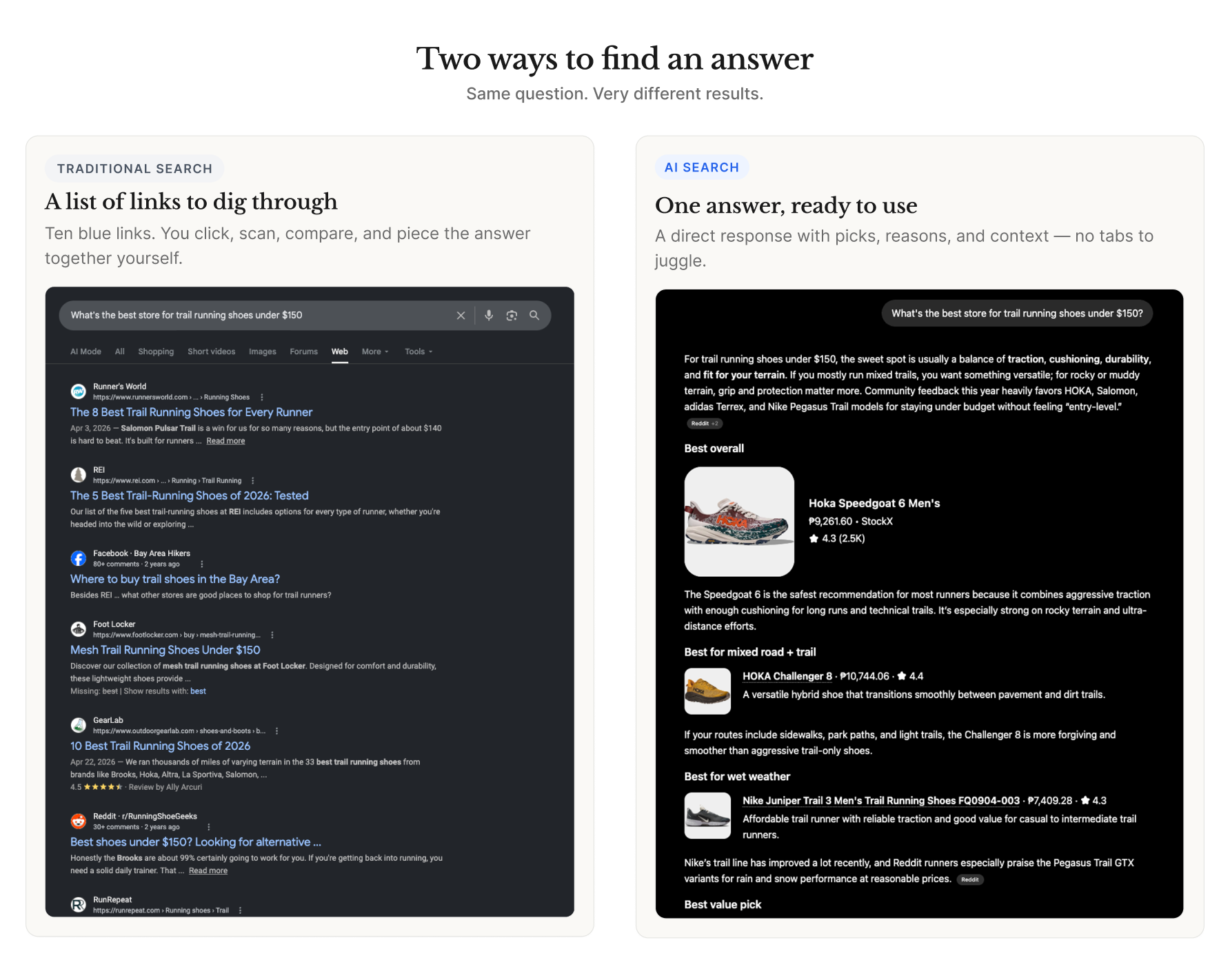
AI search is driving the shift to zero-click shopping, where the answer shows up without the shopper clicking through to ten different sites. If AI isn’t surfacing your store, you’re invisible to the shopper.
The flip side is encouraging. A citation inside an AI answer tends to bring higher-intent visitors than a random organic click. Just because the AI has already vouched for you. That’s why getting your AI search visibility right is worth the effort now, while most stores haven’t started.
How do AI search engines decide which stores to mention?
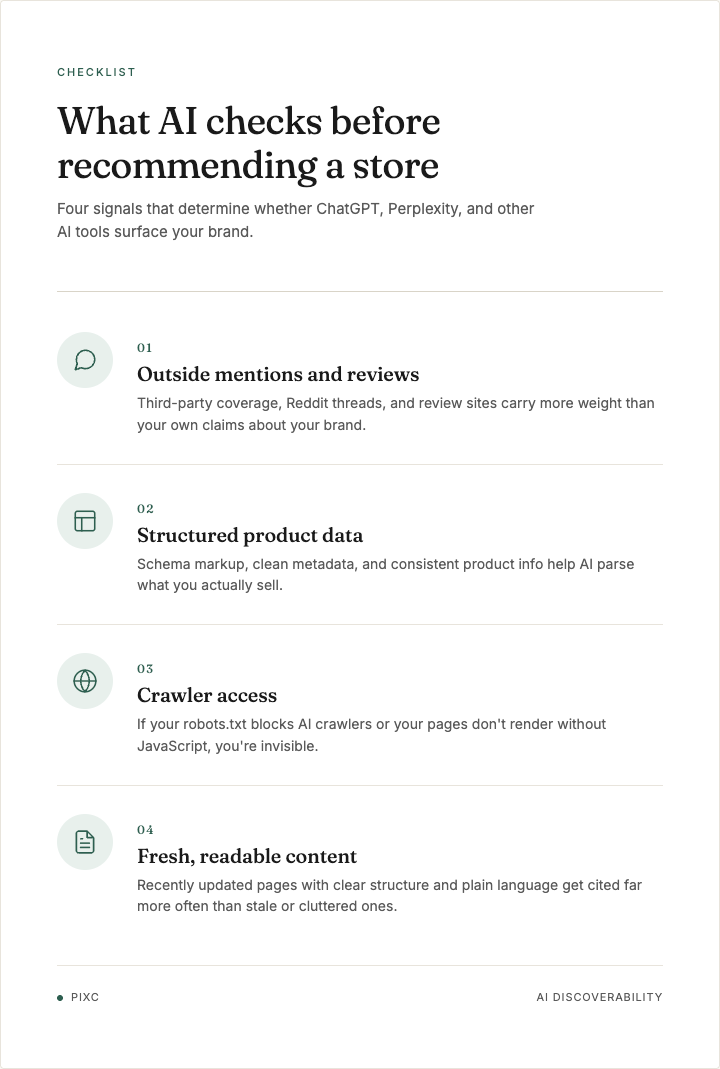
AI engines mention stores they see as trustworthy and easy to read. They weigh four things:
- How much do other sites talk about you (reviews and Reddit, especially)
- How clear and structured your product data is
- Whether AI crawlers can access your site, and
- How fresh and readable your content is
Outside mentions and authority matter more than keywords.
This is the core of generative engine optimization, or GEO, the practice of structuring your content and data so AI engines can find you, trust you, and recommend you. Traditional SEO chases keyword rankings and clicks. GEO chases citations within AI answers and rewards fact density, clear structure, and credibility over keyword stuffing. The Salsify and Mirakl guides I mentioned above describe what AI looks for as “machine-readable truth” — bullet points, tables, and clean facts over flowery marketing copy.
The numbers back up where AI puts its trust. Domain traffic is the biggest predictor of AI citations — high-traffic sites earn roughly 3x more citations. And 85% of brand citations in AI answers come from third-party pages, not your own site.
In other words, what other people say about you online matters more than what you say about yourself. Keep that in mind as we go, because it shapes the whole playbook below. Here’s how to strengthen each of the four things AI checks.
1. Build authority where AI actually looks
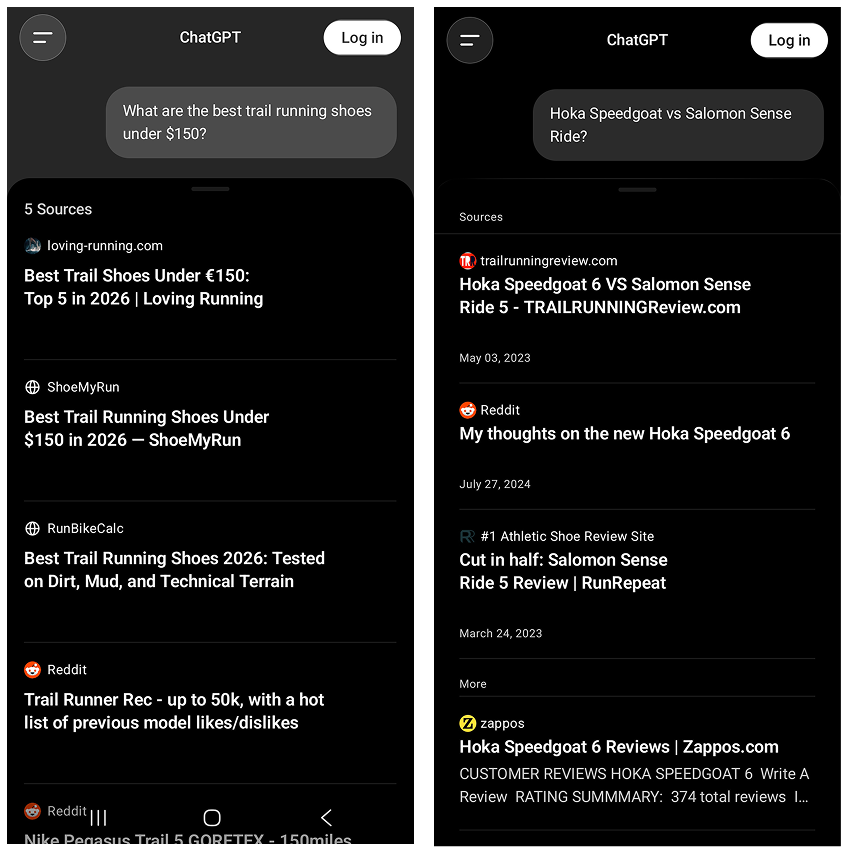
Here’s what matters most: the brand mentions AI weighs heaviest aren’t on your own site, they’re on third-party pages. So your first job is to show up credibly in the places AI reads. ChatGPT references reviews in 58% of its responses, while Perplexity leans on them close to 100% of the time. Here’s where you should focus:
- Get reviews on third-party platforms, not just your own site. Reviews that lack substance or reviews that live in only one place give AI less to work with.
- Show up in community threads. The 2026 AI search data shows pages mentioned often on Reddit and Quora earn far more citations, so answer questions in your niche and get your products into genuine recommendation threads.
- Earn spots in “best of” and roundup lists. These comparison articles are exactly what AI pulls from when a shopper asks for options.
- Keep your brand description consistent everywhere. Use the same clear line about what you sell across your site, social profiles, and any directory or marketplace listing, so AI builds one confident picture of you.
There’s no shortcut here, and that’s the point.
A consistent, credible presence across the web helps with two things. First, it helps you stand out from the competition in ecommerce. And second, it builds the AI brand mentions that get your store surfaced in AI-generated answers.
2. Make your product data easy for AI to read
AI doesn’t read your pretty product pages the same way a human does. They pull from your structured data: the metafields, schema markup, titles, and tags that describe a product in plain, machine-readable facts. Shopify’s own guides on Perplexity and Google AI shopping report that stores with 99%+ attribute completion see 3 to 4 times higher AI visibility, and it’s mostly filling in fields you already have. Work through these:
- Complete every product attribute. Fill in material, dimensions, weight, care instructions, and compatibility wherever they apply, using your metafields.
- Write specific titles and tags. A t-shirt tagged “cotton, unisex, graphic tee, heavyweight” beats one tagged only “apparel,” and “Texturizing Sea Salt Hair Spray, 8oz” beats “The Dreamcatcher” when AI is matching products to a shopper’s question.
- Add schema markup to your product pages. It hands AI clean, labeled facts instead of making it guess.
- Write descriptive alt text for every image. AI can’t see a photo, so alt text tells it exactly what’s shown, and clean, well-sized files keep your pages fast and easy to crawl.
If you want the broader picture on getting your visuals right, our guide to ecommerce image optimization covers the fundamentals. Clean, retail-ready product photos paired with accurate alt text give AI a clear, consistent read on what you sell.
3. Allow AI crawlers to read your store
AI engines use their own crawlers, like OpenAI’s GPTBot and oai-searchbot, and Perplexity’s PerplexityBot. If your site blocks them in your robots.txt file, you simply won’t appear in those AI answers. Allow the AI crawlers, add an llms.txt file to guide them to your best content, and use a clean schema so they can read your pages.
Think of this as opening the front door. AI tools can only recommend stores they’re allowed to read. Unfortunately, many sites quietly block these newer bots without realizing it. It’s a small technical step, but skip it, and everything else in this guide is pointless, because AI never gets to see your hard work. Three things to check:
- Allow AI crawlers in your robots.txt. Make sure OpenAI’s GPTBot and oai-searchbot, plus Perplexity’s PerplexityBot, aren’t blocked in your Shopify settings.
- Add an llms.txt file. It’s a simple text file that points AI to the content you most want it to understand, like a sitemap written for AI, and Shopify ecosystem tools can generate one for you.
- Use a clean schema and clear headings. The 2026 citation data found pages with sequential headings and rich schema markup earn about 2.8x higher citation rates, so structure pays off directly.
4. Publish content AI wants to quote
Beyond product pages, the content on your blog and help pages is what AI pulls from to answer the bigger questions shoppers ask. The trick is to write so it’s easy to extract and quote. Content with a clear Q&A structure gets surfaced in AI answers more reliably. Here are good habits to build:
- Use question-style headings. Phrase headers the way people actually ask, and give a clear answer in the first sentence or two before you expand.
- Keep it readable. The latest research shows that content at a 6th to 8th grade reading level earns more AI citations than dense, academic writing, so short sentences and plain words win.
- Refresh your content quarterly. Pages not updated at least every quarter are about 3x more likely to lose their citations, so do a regular pass to update stats, prices, and details.
- Add an FAQ section with FAQ schema (like this one in this blog below). It gives AI clean, self-contained answers that it can grab in one piece.
It’s a nice case of one effort doing two jobs: the same writing that helps a busy shopper understand you also helps AI quote you. If you’re building out this habit, our take on blogging for your ecommerce store is a good starting point.
How do you track if AI is mentioning your store?
Now that you’re optimizing your store for AI, you’ll want to know if it’s actually working. Here how you can start tracking:
- Start by asking ChatGPT, Claude, and Google AI Overviews two types of questions: one that mentions your store by name (for example, “Is [your store] good for X?”) and one about your product category without naming you (for example, “best store for trail running shoes”). Note whether your store appears in either. For ongoing tracking, free tools like Semrush’s AI search visibility checker show where you’re cited, and your GA4 referral data reveals whether AI tools are actually sending you traffic.
- A manual check is the fastest way to start, and it costs nothing. Ask the AI tools the same questions your customers would, like “best store for X” or “where to buy Y,” and see who gets named. Do this every few weeks so you can spot whether your work is moving the needle. It’s rough, but it’s real, and it tells you exactly what shoppers are seeing.
- For something more systematic, dedicated AI visibility tools track your mentions across platforms over time. Semrush offers a free checker to get you started. Also, watch your GA4 data for referral traffic from AI sources, since that’s the clearest sign AI is not just mentioning you but sending real visitors. Once visitors arrive, the same conversion basics apply: a fast site, clear product pages, trust signals like reviews, and a simple checkout. So make sure you’re set up to turn that traffic into sales rather than letting it bounce.
AI search optimization: Start small, start now
Here’s the reassuring part: AI search optimization isn’t a brand-new skill set you have to learn from scratch. It’s the same clear data, real authority, and readable content that already make a good store, now pointed at a new audience of AI engines. The stores that get mentioned aren’t the ones with the cleverest tricks. They’re the ones AI can read and trust easily.
If you do nothing else this month, do two things: make sure AI crawlers can reach your site, and clean up your product data so it reads clearly. Those two moves unlock everything else. A simple place to begin is your images, since AI relies on descriptive alt text to understand them. Add accurate alt text across your catalog with Auto Alt Text by Pixc, so every product photo tells AI exactly what it’s looking at. Get the foundation right now, while most stores still haven’t, and you’ll be the one AI names when a shopper asks.